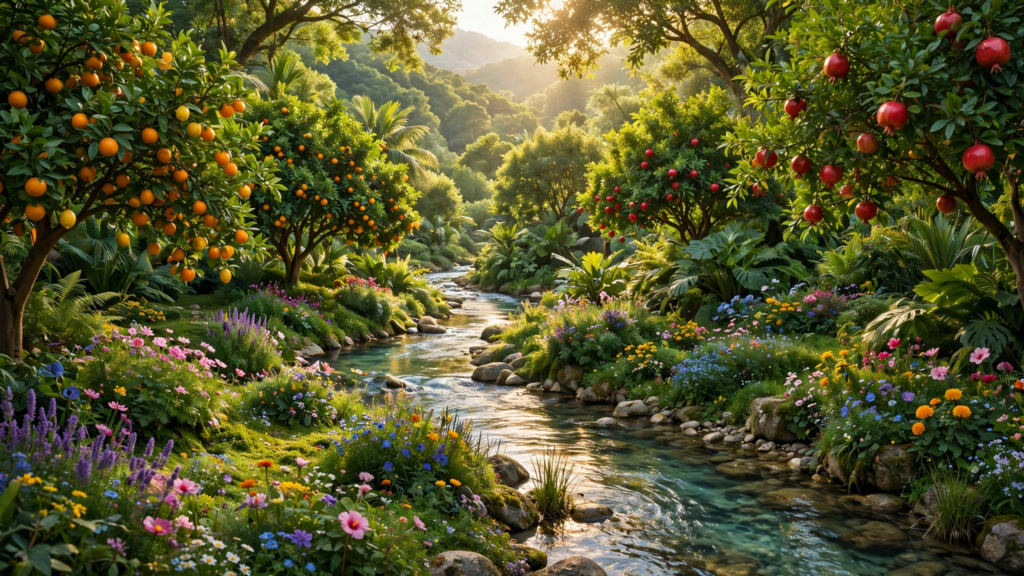
The Garden of Eden is the garden described in the first book of the Bible, Genesis, as the first home of Adam and Eve. According to the account in Genesis chapters 2 and 3, God planted the garden in a region called Eden, placed the first man and woman there, and gave them one command: they could eat from every tree except the tree of the knowledge of good and evil. When they ate from that tree after being persuaded by the serpent, they were driven out of the garden.
What Is the Garden of Eden?
In the Genesis account, the Garden of Eden is a planted garden, not a wild forest. Genesis 2:8 says that God planted a garden in Eden, in the east, and placed there the man he had formed. The garden is described as full of trees that were pleasant to look at and good for food, watered by a river, and given to the man to work and take care of.
In Genesis, Eden is the wider region, and the garden is a particular place planted within it. Later passages sometimes use the two names loosely, so people usually say "the Garden of Eden" to mean both.
The name itself is part of the picture. The Hebrew word Eden is widely understood to be linked to a root meaning delight or pleasure, so the garden is presented as a place of delight. Some scholars also connect the name to an ancient word for a plain or open country.
Two trees in the middle of the garden matter most to the story. One is the tree of life. The other is the tree of the knowledge of good and evil. The man and woman were free to eat from every tree except the second one, and the warning was clear: eating from it would bring death.
The Story of Adam and Eve
The story in Genesis 2 and 3 can be told in a few clear steps.
First, God forms the man, Adam, from the ground and breathes life into him. He places him in the garden, gives him work to do, and gives him the one command about the tree of the knowledge of good and evil.
Then God forms the woman, Eve, as a companion for the man. Genesis describes her as made from the man's side, and the two are presented as partners in the garden, living without shame.
Then the serpent enters the story. In Genesis 3, the serpent speaks to the woman and questions the command about the tree. It suggests that eating the fruit will open their eyes and make them like God, knowing good and evil. The woman eats the fruit and gives some to the man, who eats as well.
At once, the account says, their eyes are opened. They realize they are naked, feel shame for the first time, and hide from God among the trees. When God questions them, the man blames the woman, and the woman blames the serpent.
Then comes the judgment. God pronounces consequences for the serpent, the woman, and the man: the ground is cursed, work becomes painful toil, and death enters the picture. God clothes them, then sends them out of the garden, placing cherubim and a flaming sword at the east side to guard the way to the tree of life.
Where Was the Garden of Eden Said to Be?
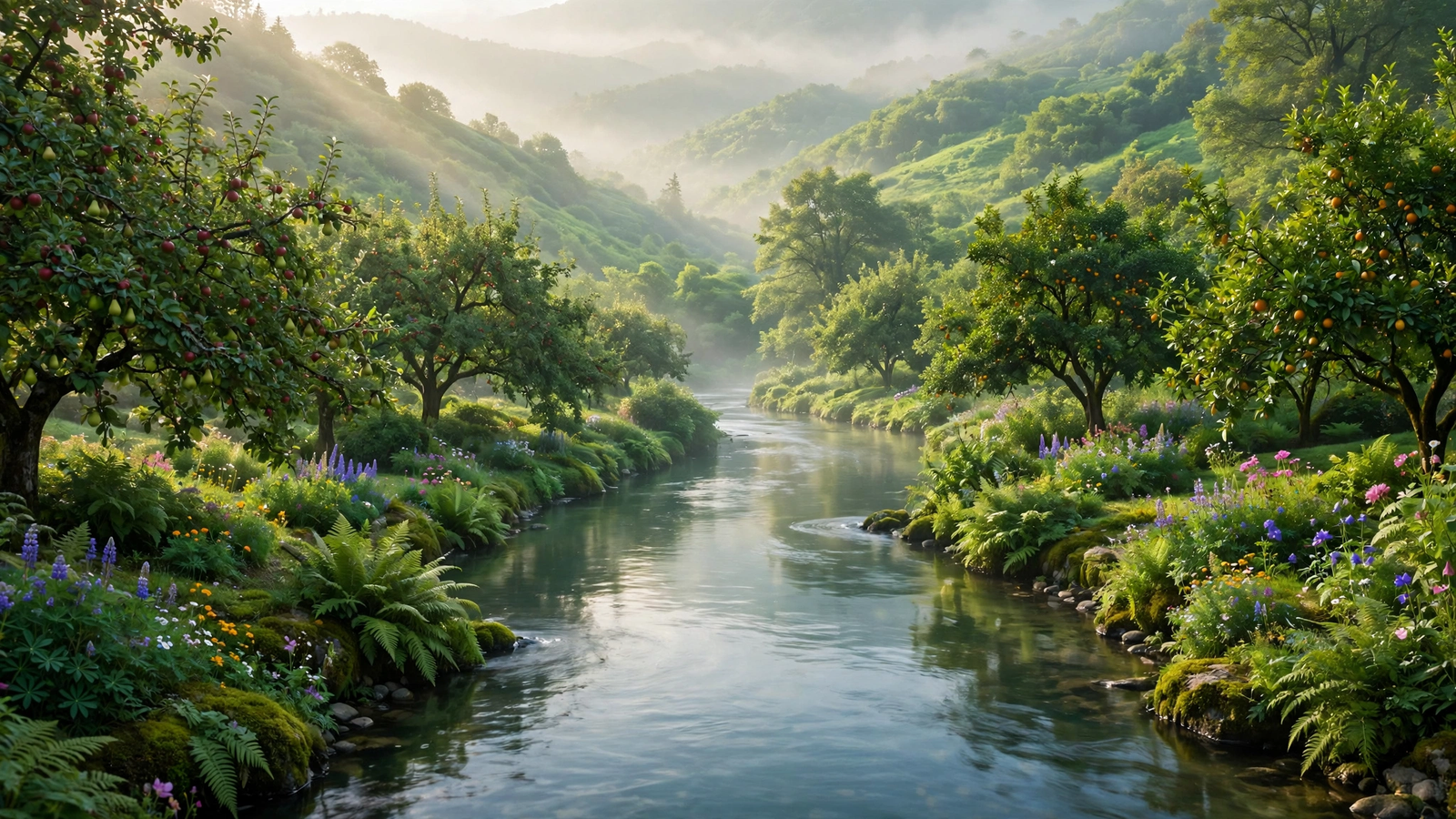
Genesis gives the garden a geography, but it is a geography that no one has been able to pin down on a modern map. Genesis 2:10 to 14 says that a river flowed out of Eden to water the garden, and from there it divided into four headwaters.
The Pishon winds through the whole land of Havilah, a land described as having good gold, aromatic resin, and onyx. The Gihon winds through the whole land of Cush. The Tigris runs along the east side of Ashur, that is, Assyria. The Euphrates is named without further description, presumably because its first readers knew it well.
Two of these rivers can be identified with confidence: the Tigris and the Euphrates, the great rivers of Mesopotamia. The Pishon and the Gihon cannot be identified with certainty. One river dividing into four also runs against how rivers normally behave, since tributaries usually join to form a larger stream rather than splitting from one source.
Over the centuries, many locations have been proposed, from the highlands of eastern Anatolia and Armenia, where the Tigris and Euphrates both rise, to southern Mesopotamia near the head of the Persian Gulf. Others have identified the Pishon and Gihon with the Ganges and the Nile, or with ancient canals and dry riverbeds in Arabia. None of these proposals has won general agreement.
The honest answer is that the location of the Garden of Eden is not known. The text points toward the region of Mesopotamia and the Fertile Crescent, the broad band of fertile land stretching from the Persian Gulf through what is now Iraq and Syria. But the exact site cannot be fixed.
What the Garden of Eden Means in Judaism
In Jewish tradition, the Garden of Eden is the setting of the first human story and a lasting image of the world as God intended it. Genesis is read as the account of how humanity began in closeness to God and how disobedience brought exile and hardship into human life. The Hebrew name Gan Eden also became, in later Jewish thought, the name for the dwelling place of the righteous after death.
Jewish interpreters have also read the story in different ways across the centuries. Some have read it as a straightforward account of real events. Others, such as the first century thinker Philo of Alexandria, read the garden as an allegory of the soul and of virtue.
What the Garden of Eden Means in Christianity
In Christian tradition, the Garden of Eden is the starting point of the whole biblical story. It shows humanity in its original state: made in God's image, living in fellowship with God, and given meaningful work in a good world. The fall of Adam and Eve is then understood as the moment when sin and death entered the world.
The New Testament draws on Eden in several ways. Paul presents Christ as the counterpart of Adam: through one man sin and death entered the world, and through one man come righteousness and life. The word paradise, which comes from the Greek word used for the garden, appears when Jesus tells the dying criminal that he will be with him in paradise, and when the risen Christ promises the right to eat from the tree of life.
The final chapters of the Bible return to Eden's imagery. In Revelation, a river of the water of life flows from the throne of God, the tree of life stands on each side bearing fruit every month, and the curse is gone. For Christian readers, the story that begins in a garden ends in a garden city, the New Jerusalem, where God dwells with his people and the way back to the tree of life is open again.
What the Garden of Eden Means in Islam
The Garden of Eden also appears in Islamic tradition, where it is known as Jannat al-Adn, the Garden of Eden, or more often simply as Jannah, paradise. The Quran tells the story of Adam and his wife in the garden, the command not to approach a particular tree, the whispering of Satan that led them to eat from it, and their removal from the garden to live on earth.
There are differences of emphasis between the Islamic account and the Genesis account. In the Quran, Adam and his wife both bear responsibility for eating from the tree, and Adam repents and is forgiven by God. The story is often read as a lesson in human weakness, repentance, and God's mercy, rather than as an inherited sin passed to all humanity.
In Islam, the Garden of Eden is also a name for paradise itself, the reward promised to the righteous in the life to come: gardens beneath which rivers flow, described in the Quran as a place of peace, beauty, and nearness to God.
The Garden of Eden as a Symbol
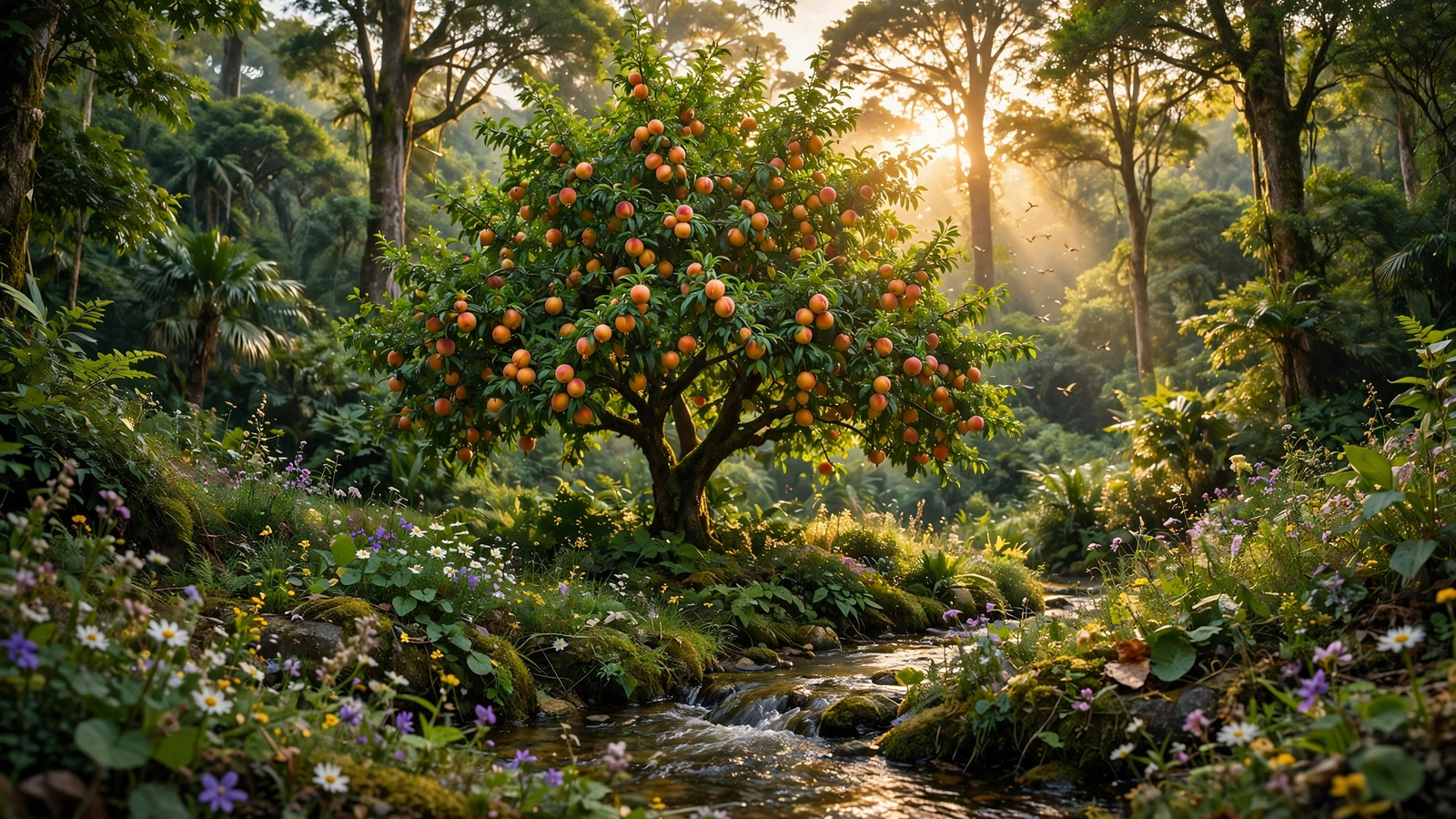
Beyond its religious meanings, the Garden of Eden has become one of the most widely used symbols in Western culture. It stands for a lost paradise, a perfect beginning, innocence before experience, and a world without pain, work, or death. To call something an Eden, or to describe a place as Edenic, is to say it feels untouched, beautiful, and full of life.
The image also carries its darker side. Eden is a paradise lost, so it is often used to talk about longing for something that cannot be recovered, or about the moment when innocence ends. The phrase "the forbidden fruit" has entered everyday language to mean something tempting precisely because it is forbidden.
The garden has also been a powerful subject for artists. Painters such as Jan Brueghel the Elder and Peter Paul Rubens filled their Garden of Eden with animals, fruit trees, and soft light, imagining a world where wild creatures and people lived side by side in peace. Michelangelo painted the temptation on the ceiling of the Sistine Chapel.
In literature, the story has been retold and reworked again and again. John Milton's epic poem Paradise Lost, published in 1667, is the most famous example. It retells the fall of Adam and Eve in grand verse and gave English literature many of its lasting images of Eden, the serpent, and the loss of paradise.
Frequently Asked Questions
Was the Garden of Eden a real place?
That depends on what is meant by real. The Genesis account presents the garden as a real place with named rivers and lands, and many readers in Judaism, Christianity, and Islam have understood it that way. Others read the story as a teaching narrative whose meaning does not depend on finding its site on a map. What can be said plainly is that no location has been proven, and scholars disagree about whether the river description was meant as literal geography.### What does Eden mean?
The name Eden is generally linked to a Hebrew root meaning delight or pleasure, so the Garden of Eden is a garden of delight. Some scholars also connect it to an ancient word meaning a plain or open country. The Greek translation of the Old Testament rendered garden with the word paradeisos, which gave English the word paradise.
Where is the Garden of Eden today?
Its location is not known. Genesis names four rivers, the Pishon, the Gihon, the Tigris, and the Euphrates, and the Tigris and Euphrates point toward Mesopotamia, in the region of modern Iraq. But the Pishon and Gihon cannot be identified with certainty, and no site has won general agreement.
What fruit did Adam and Eve eat?
Genesis does not say. It speaks only of the fruit of the tree of the knowledge of good and evil. The idea that it was an apple comes from later art and tradition, not from the text of Genesis.
Why were Adam and Eve driven out of the garden?
According to Genesis, they were driven out after they disobeyed the one command and ate from the forbidden tree. God sent them out to work the ground, and placed cherubim and a flaming sword at the entrance to guard the way to the tree of life, so they could not eat from it and live forever in their fallen state.
What is the tree of life?
The tree of life is one of the two named trees in the middle of the garden. In Genesis, it is not forbidden to eat from, but after the fall, access to it is closed off. In later biblical writing, it becomes a symbol of life, wisdom, and restoration, and it reappears in the final chapters of Revelation.
Conclusion
The Garden of Eden is a short story with a very long reach. In Genesis, it is the first home of Adam and Eve: a watered garden full of fruit trees, given to humanity to tend, with one command and two trees at its center. The story of the serpent, the forbidden fruit, and the expulsion has been read for thousands of years as an account of how innocence was lost and how work, pain, and death entered human life.
Its meaning differs between traditions. In Judaism, Eden is both the first garden and the name of paradise for the righteous. In Christianity, it is the beginning of a story that runs from creation to the fall and on to restoration. In Islam, it is the garden of Adam, a lesson in repentance and mercy, and a name for the paradise promised to believers. Beyond religion, Eden has become a shared image of a lost paradise and a hope that what was lost might one day be restored.