
Sulfur dioxide, written SO2, has a Lewis structure with sulfur in the middle, two oxygen atoms joined to it, and 18 valence electrons. The form most textbooks use has two double bonds, one from sulfur to each oxygen, with one lone pair on sulfur and two lone pairs on each oxygen. This guide draws it in six steps, checks the formal charges, and shows the second resonance form.
The Answer Up Front
Here is the finished SO2 Lewis structure in text form. The dots stand for lone pair electrons, and the double lines stand for double bonds.
“`
.. ..
: O = S = O :
.. ..
“`
Read it as O=S=O: one lone pair on sulfur, two lone pairs on each oxygen. Sulfur sits in the center because it is less electronegative than oxygen. Each oxygen has a full octet of 8 electrons, and sulfur holds 10, an expanded octet allowed for sulfur in period 3.
| Fact | Value |
|---|---|
| Formula | SO2 |
| Total valence electrons | 18 |
| Central atom | Sulfur |
| Bonds | Two S=O double bonds |
| Lone pairs on sulfur | 1 |
| Lone pairs on each oxygen | 2 |
| Shape | Bent |
| Bond angle | About 119 degrees |
Step 1: Count the Valence Electrons
Sulfur is in group 16, so it has 6 valence electrons. Each oxygen is also in group 16, so each one has 6. That gives 6 + 6 + 6 = 18 valence electrons in total.
You will use every one of these 18 electrons, so if you have any left over or run out early, you have made a mistake.
“`
“`
Step 2: Pick the Central Atom
Sulfur goes in the middle, with an oxygen on each side. The least electronegative atom goes in the center, and sulfur is less electronegative than oxygen.
“`
O S O
“`
Step 3: Draw Single Bonds
Join each oxygen to sulfur with a single bond. Each bond uses 2 electrons.
“`
O – S – O
“`
You have now used 4 of your 18 electrons. That leaves 14 electrons to place as lone pairs.
Step 4: Fill the Outer Atoms First
Put lone pairs on the oxygen atoms until each one has a full octet of 8 electrons. Each oxygen already shares 2 electrons in its bond, so each one needs 6 more, which is 3 lone pairs.
“`
.. ..
: O – S – O :
.. ..
“`
That is 12 electrons as lone pairs, plus 4 bonding electrons, so 16 used and 2 left.
Step 5: Put the Last Pair on Sulfur
Place the final 2 electrons on sulfur as one lone pair.
“`
.. ..
: O – S – O :
.. .. ..
“`
All 18 electrons are placed, but sulfur has only 6 around it, so turn single bonds into double bonds.
Step 6: Make Double Bonds
Move one lone pair from each oxygen into a shared bond with sulfur. Each oxygen now shares 4 electrons with sulfur instead of 2.
“`
.. ..
: O = S = O :
.. ..
“`
Count once more: each oxygen has 4 in its double bond plus 4 in its lone pairs, a full octet of 8. Sulfur has 8 in its two double bonds plus 2 in its lone pair, 10 in total, an expanded octet. This is the finished structure, the one to draw first.
Formal Charge Check
Formal charge tells you whether a structure is stable: formal charge equals valence electrons minus nonbonding electrons minus half the bonding electrons.
| Atom | Valence electrons | Nonbonding electrons | Bonding electrons | Formal charge |
|---|---|---|---|---|
| Sulfur | 6 | 2 | 8 | 6 – 2 – 4 = 0 |
| Oxygen (left) | 6 | 4 | 4 | 6 – 4 – 2 = 0 |
| Oxygen (right) | 6 | 4 | 4 | 6 – 4 – 2 = 0 |
Every atom has a formal charge of zero. That is the best possible result, and the main reason this version is the standard answer. Remember to subtract half the bonding electrons, not all of them: a double bond has 4 bonding electrons, so you subtract 2.
The Second Resonance Form
SO2 has a second resonance form, with one double bond and one single bond.
“`
.. ..
: O = S – O :
.. .. ..
“`
Here the oxygen with the single bond carries a formal charge of negative 1, and sulfur carries a formal charge of positive 1. The charges add up to zero, which matches the neutral molecule, but this form is less stable than the version where every charge is zero.
The real molecule blends both forms: the two sulfur to oxygen bonds are identical, each somewhere between a single bond and a double bond. Chemists draw both forms with a double headed arrow between them.
“`
O=S-O <-> O-S=O
“`
Use the two double bond form as your main answer, because it has zero formal charges and it is what most textbooks show. If your teacher follows the strict octet rule, they may want the form with one double bond and one single bond, where sulfur has exactly 8 electrons around it. If you are unsure, draw the two double bond form first and add the second form beside it.
Shape, Bond Angle, and Polarity
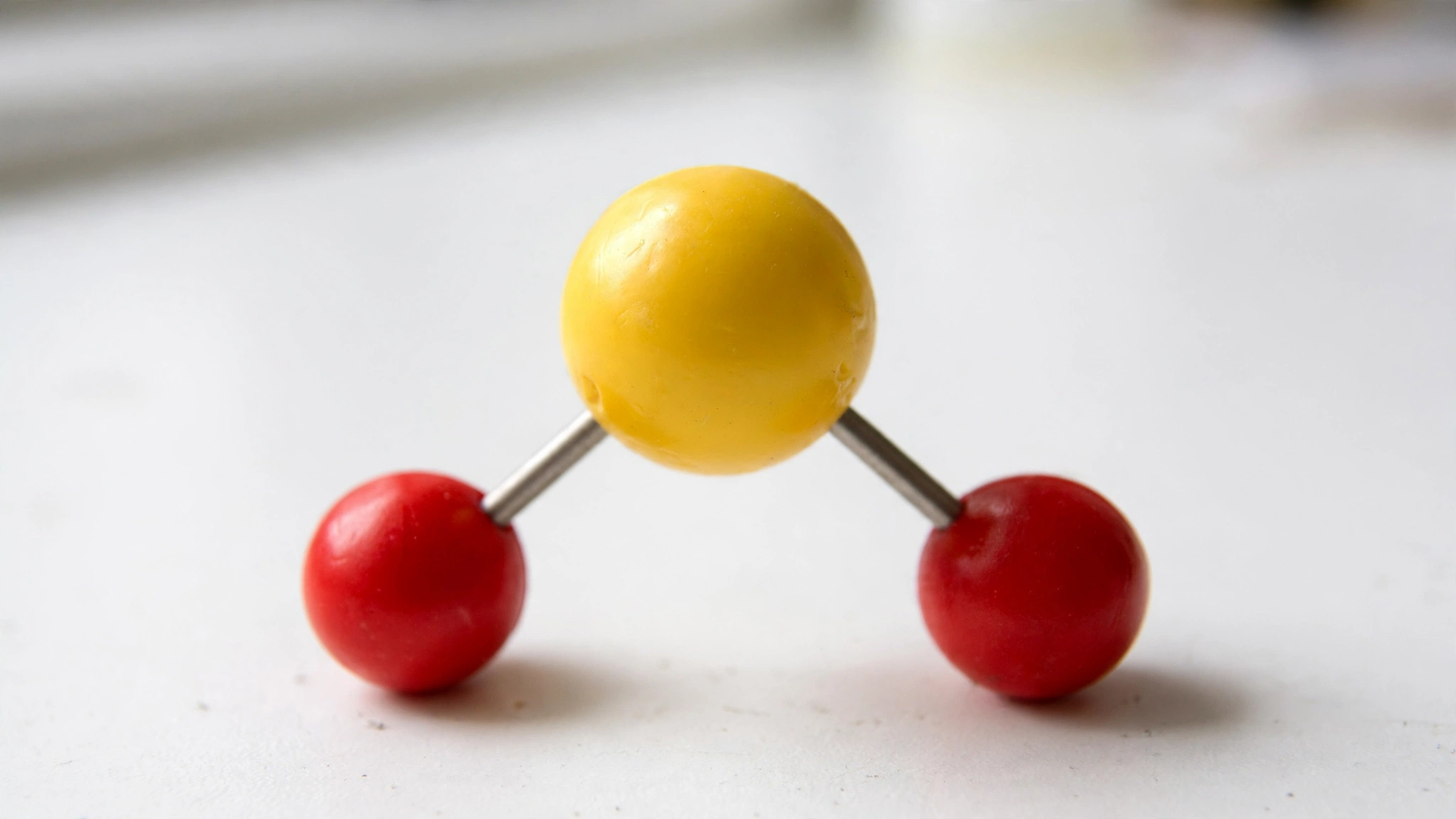
Sulfur has three electron groups around it: two bonds and one lone pair. They spread into a trigonal planar arrangement, but the lone pair pushes the oxygen atoms down, so the molecule is bent.
| Property | SO2 |
|---|---|
| Electron groups on sulfur | 3 (2 bonds + 1 lone pair) |
| Electron geometry | Trigonal planar |
| Molecular shape | Bent |
| Bond angle | About 119 degrees |
| Polar or nonpolar | Polar |
| Why it is polar | The bent shape means the bond dipoles do not cancel |
The bond angle is about 119 degrees, slightly less than the 120 degrees of a perfect trigonal planar shape, because the lone pair takes up more space than a bond. SO2 is polar because the bent shape stops the two bond dipoles from canceling each other out. Compare it with carbon dioxide, CO2, which is linear and nonpolar even though it also has polar bonds.
5 Common Mistakes

1. Counting 16 valence electrons instead of 18. Sulfur is in group 16, so it has 6, not 4.
2. Putting oxygen in the center. Oxygen is more electronegative than sulfur, so it goes on the outside.
3. Leaving single bonds in the final structure. If you stop after step 5, sulfur has only 6 electrons. You must form the double bonds.
4. Messing up the formal charge math. Subtract half the bonding electrons, not all of them.
5. Drawing sulfur with no lone pair. Without it, you have only used 16 electrons, and the molecule would have the wrong shape.
Practice Questions
1. How many valence electrons does SO2 have? 6 from sulfur and 6 from each oxygen, so 18.
2. What is the formal charge on sulfur in the two double bond form? Sulfur has 6 valence electrons, 2 nonbonding, and 8 bonding, so 6 – 2 – 4 = 0.
3. Why is SO2 bent instead of linear? Sulfur has one lone pair as well as two bonds, and the lone pair pushes the oxygen atoms down. Without it, the molecule would be linear like CO2.
Frequently Asked Questions
How many valence electrons are in SO2?
SO2 has 18 valence electrons: 6 from sulfur and 6 from each oxygen.
What is the Lewis structure of SO2?
The standard SO2 Lewis structure has sulfur in the center with two double bonds, one lone pair on sulfur, and two lone pairs on each oxygen. Sulfur holds 10 electrons, an expanded octet.
Is SO2 polar or nonpolar?
SO2 is polar, because its bent shape stops the two bond dipoles from canceling out.
What is the bond angle of SO2?
The bond angle of SO2 is about 119 degrees, slightly less than the 120 degrees of a perfect trigonal planar shape, because the lone pair takes up extra space.
Why does sulfur have 10 electrons in SO2?
Sulfur is in period 3, so it can hold more than 8 electrons. This expanded octet gives zero formal charges on every atom, which makes it the most stable form.
Does SO2 have resonance structures?
Yes. SO2 has two resonance forms: the two double bond form with zero formal charges, and the form with one double bond and one single bond, where sulfur is positive 1 and one oxygen is negative 1. The real molecule blends the two, with both bonds identical.
Conclusion
The SO2 Lewis structure tests the skills that matter: counting valence electrons, picking the right central atom, filling octets, and checking formal charges. Draw it in six steps, finish with two double bonds, and confirm every formal charge is zero. Then remember the second resonance form and the bent shape.