
Carbon dioxide, written CO2, has a Lewis structure with carbon in the middle, two oxygen atoms joined to it, and 16 valence electrons. The correct form is O=C=O: a double bond from carbon to each oxygen, two lone pairs on each oxygen, and no lone pair on carbon. This guide draws it in six steps, checks the formal charges, and explains why the molecule is linear and nonpolar.
The Answer Up Front
Here is the finished CO2 Lewis structure in text form. The dots stand for lone pair electrons, and the double lines stand for double bonds.
“`
.. ..
: O = C = O :
.. ..
“`
Read it as O=C=O: two double bonds, two lone pairs on each oxygen, and no lone pair on carbon. Carbon sits in the center because it is less electronegative than oxygen, and each atom has a full octet of 8 electrons.
| Fact | Value |
|---|---|
| Formula | CO2 |
| Total valence electrons | 16 |
| Central atom | Carbon |
| Bonds | Two C=O double bonds |
| Lone pairs on carbon | 0 |
| Lone pairs on each oxygen | 2 |
| Shape | Linear |
| Bond angle | 180 degrees |
Step 1: Count the Valence Electrons
Carbon is in group 14, so it has 4 valence electrons. Each oxygen is in group 16, so each one has 6. That gives 4 + 6 + 6 = 16 valence electrons in total.
You will use every one of these 16 electrons, so if you have any left over or run out early, you have made a mistake.
“`
“`
Step 2: Pick the Central Atom
Carbon goes in the middle, with an oxygen on each side. The least electronegative atom goes in the center, and carbon is less electronegative than oxygen.
“`
O C O
“`
Step 3: Draw Single Bonds
Join each oxygen to carbon with a single bond. Each bond uses 2 electrons.
“`
O – C – O
“`
You have now used 4 of your 16 electrons. That leaves 12 electrons to place as lone pairs.
Step 4: Fill the Outer Atoms First
Put lone pairs on the oxygen atoms until each one has a full octet of 8 electrons. Each oxygen already shares 2 electrons in its bond, so each one needs 6 more, which is 3 lone pairs.
“`
.. ..
: O – C – O :
.. ..
“`
That is 12 electrons as lone pairs plus 4 bonding electrons, so all 16 are now used. Carbon has only 4 electrons around it, so the structure is not finished yet.
Step 5: Check the Central Atom
Count the electrons around carbon: two single bonds give it only 4 electrons, far short of an octet of 8, while each oxygen already has a full octet. The fix is to turn lone pairs on oxygen into extra bonds.
Step 6: Make Double Bonds
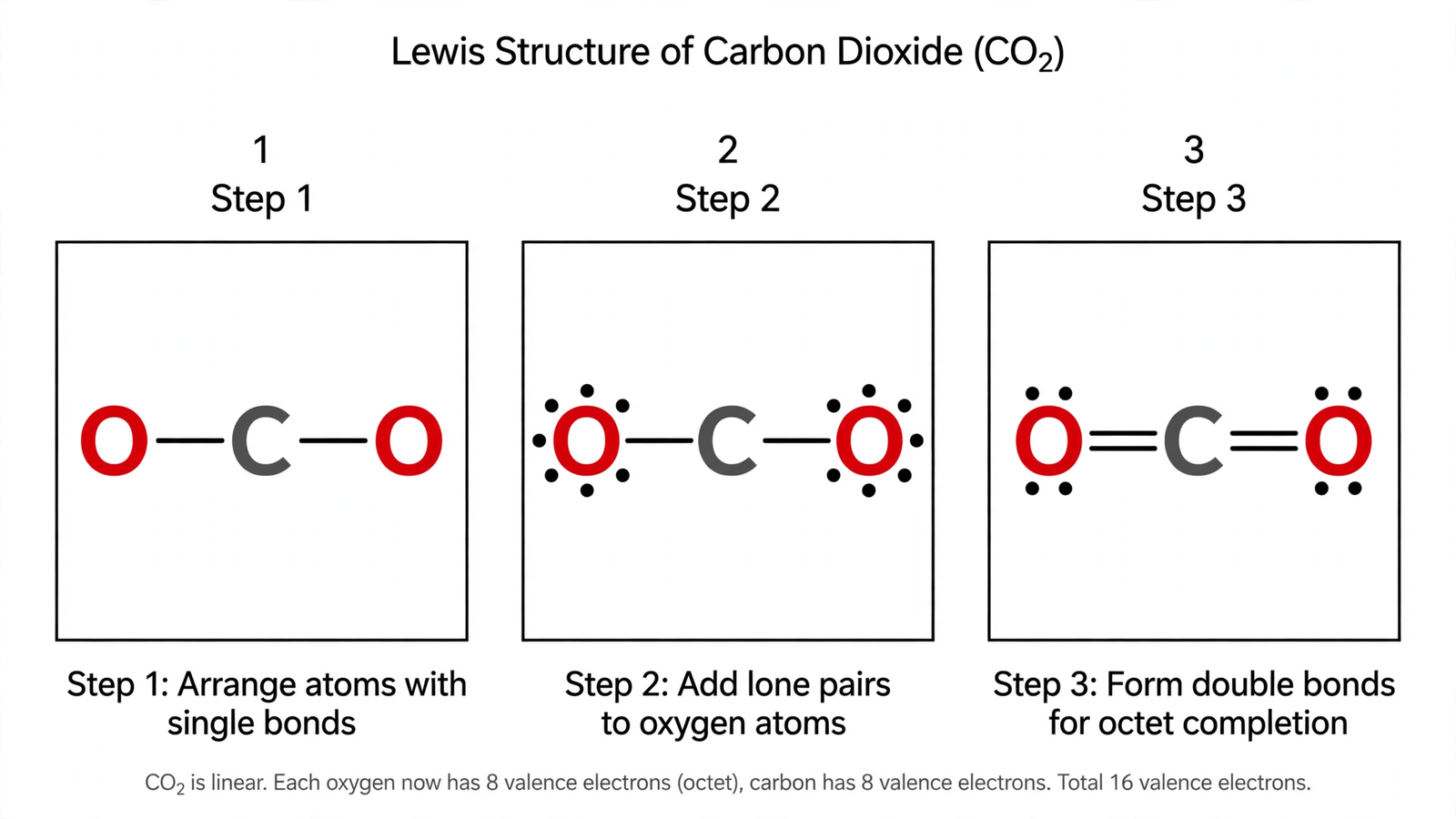
Move one lone pair from each oxygen into a shared bond with carbon. Each oxygen now shares 4 electrons with carbon instead of 2, and each oxygen keeps 2 lone pairs.
“`
.. ..
: O = C = O :
.. ..
“`
Count once more: each oxygen has 4 in its double bond plus 4 in its lone pairs, a full octet of 8. Carbon has 8 in its two double bonds, also a full octet, with no lone pair. This is the finished structure, the one to draw first.
Formal Charge Check
Formal charge tells you whether a structure is stable: formal charge equals valence electrons minus nonbonding electrons minus half the bonding electrons.
| Atom | Valence electrons | Nonbonding electrons | Bonding electrons | Formal charge |
|---|---|---|---|---|
| Carbon | 4 | 0 | 8 | 4 – 0 – 4 = 0 |
| Oxygen (left) | 6 | 4 | 4 | 6 – 4 – 2 = 0 |
| Oxygen (right) | 6 | 4 | 4 | 6 – 4 – 2 = 0 |
Every atom has a formal charge of zero. That is the best possible result, and the main reason this version is the standard answer. Remember to subtract half the bonding electrons, not all of them: a double bond has 4 bonding electrons, so you subtract 2.
Shape, Bond Angle, and Polarity
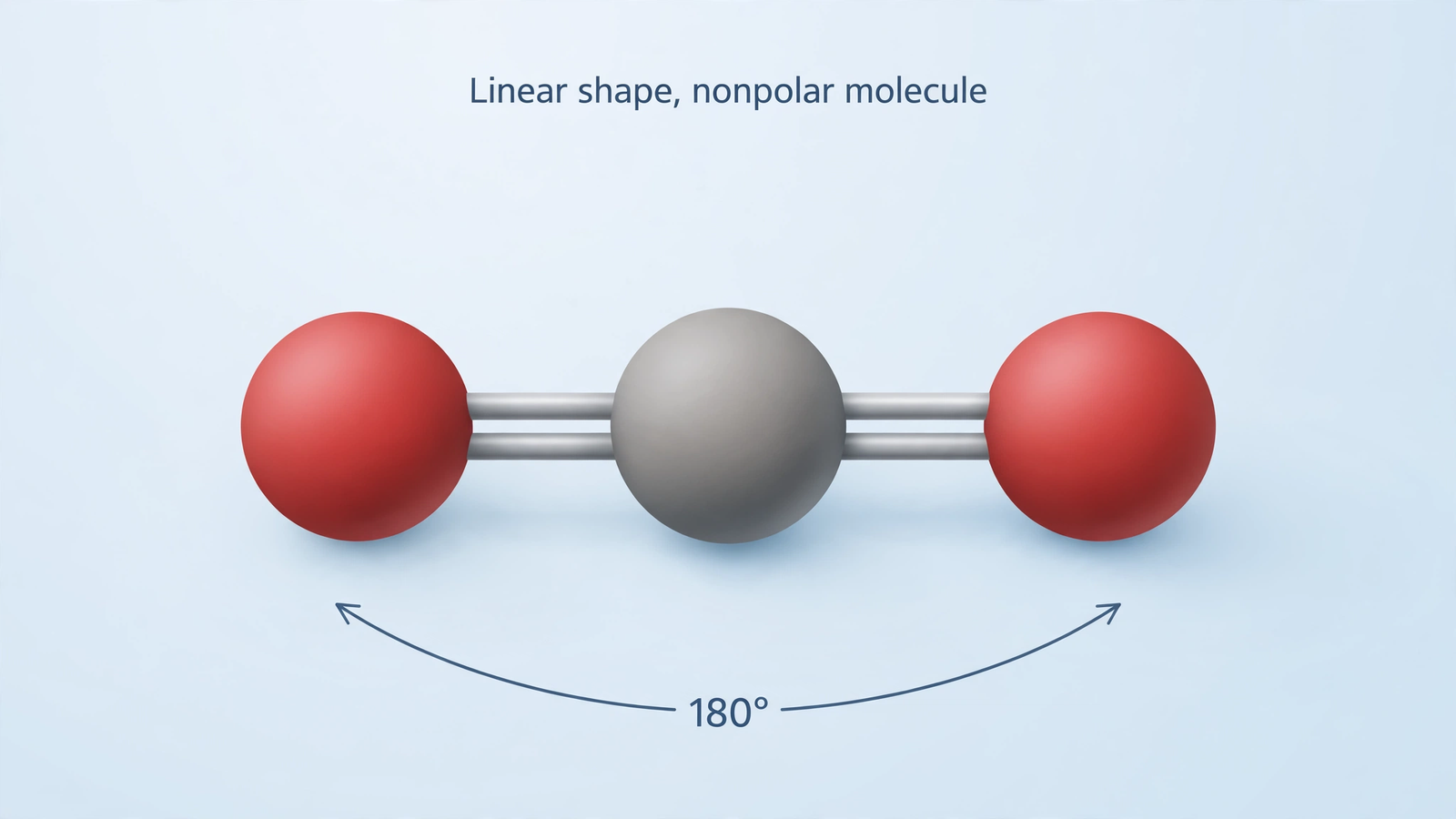
Carbon has two electron groups around it, two double bonds and no lone pair, so the oxygen atoms spread as far apart as possible, on exactly opposite sides of carbon.
| Property | CO2 |
|---|---|
| Electron groups on carbon | 2 (2 bonds + 0 lone pairs) |
| Electron geometry | Linear |
| Molecular shape | Linear |
| Bond angle | 180 degrees |
| Polar or nonpolar | Nonpolar |
| Why it is nonpolar | The two identical bond dipoles point in opposite directions and cancel |
The bond angle is exactly 180 degrees, with the two oxygen atoms in a straight line on either side of carbon. Each C=O bond is polar on its own, because oxygen (electronegativity 3.44) pulls electrons more strongly than carbon (2.55), but the two pulls are equal and opposite, so they cancel and the molecule as a whole is nonpolar.
Compare it with sulfur dioxide, SO2, which is bent and polar. SO2 has a lone pair on sulfur that pushes its oxygen atoms down, so its bond dipoles cannot cancel. CO2 has no lone pair on carbon, so it stays straight.
5 Common Mistakes
1. Counting 18 valence electrons instead of 16. Carbon has 4 valence electrons, not 6. The total of 18 belongs to SO2, where sulfur brings 6.
2. Putting oxygen in the center. Oxygen is more electronegative than carbon, so it goes on the outside. Carbon is the central atom.
3. Leaving single bonds in the final structure. If you stop after step 4, carbon has only 4 electrons around it. You must form the two double bonds.
4. Giving carbon a lone pair. There are no electrons left for carbon after step 4. Carbon has zero lone pairs in CO2.
5. Calling CO2 bent and polar. CO2 is linear, with a bond angle of 180 degrees, and nonpolar, because the two equal bond dipoles cancel. A bent shape belongs to molecules with a lone pair on the central atom, like SO2.
Practice Questions
1. How many valence electrons does CO2 have? 4 from carbon and 6 from each oxygen, so 16.
2. What is the formal charge on carbon in the O=C=O structure? Carbon has 4 valence electrons, 0 nonbonding, and 8 bonding, so 4 – 0 – 4 = 0.
3. Why is CO2 linear instead of bent? Carbon has two bonds and no lone pair, so the two electron groups sit on opposite sides of carbon, 180 degrees apart. Without a lone pair, nothing pushes the oxygen atoms off the straight line.
Frequently Asked Questions
How many valence electrons are in CO2?
CO2 has 16 valence electrons: 4 from carbon and 6 from each oxygen.
What is the Lewis structure of CO2?
The standard CO2 Lewis structure is O=C=O, with carbon in the center, a double bond to each oxygen, two lone pairs on each oxygen, and no lone pair on carbon. Every atom has a full octet and a formal charge of zero.
How many lone pairs are in CO2?
CO2 has four lone pairs in total, two on each oxygen atom. Carbon has no lone pairs.
Is CO2 polar or nonpolar?
CO2 is nonpolar. Each C=O bond is polar, but the linear shape means the two bond dipoles are equal and opposite, so they cancel out.
What is the bond angle of CO2?
The bond angle of CO2 is 180 degrees. Carbon sits between the two oxygen atoms in a straight line.
Does CO2 have resonance structures?
Some sources say CO2 has no resonance, while others list three forms. The careful answer is that O=C=O is the main form, with zero formal charges on every atom. Two minor forms also exist, each with one single bond and one triple bond, but they carry formal charges of negative 1 and positive 1 on the oxygen atoms, so they contribute much less. Draw O=C=O as your answer.
What is the difference between the CO and CO2 Lewis structures?
CO has one oxygen atom and 10 valence electrons, with a triple bond between carbon and oxygen. CO2 has two oxygen atoms and 16 valence electrons, with two double bonds. Check the formula first: if you draw only one oxygen, you have drawn carbon monoxide, not carbon dioxide.
Conclusion
Draw it in six steps, finish with two double bonds, and confirm every formal charge is zero. Then remember the straight line: two bonds, no lone pair on carbon, a 180 degree angle, and a nonpolar molecule.